
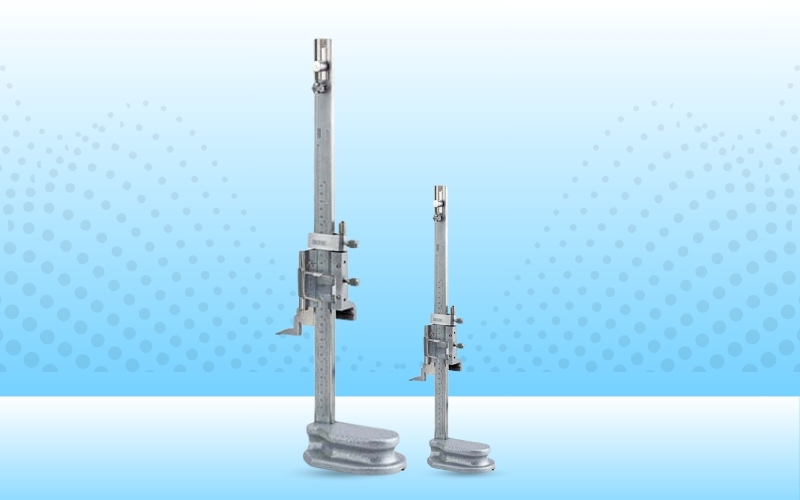
Height Gauges are indispensable tools in the realm of precision measurement, used extensively in industries that demand accuracy and consistency. These instruments measure vertical distances, verify height dimensions, and ensure precise alignment during machining and quality control processes. This blog highlights the Uses and Applications of Height Gauges, showcasing their critical role across various industries.
What are Height Gauges?
A Height Gauge is a precision instrument designed to measure vertical distances from a reference surface. Equipped with a base, vertical column, and measurement slider, height gauges are versatile tools often fitted with digital or Vernier scales for enhanced accuracy. Some models also include scribing attachments for marking dimensions on workpieces.
Top Uses of Height Gauges
1. Measuring Height Dimensions
Height Gauges are primarily used to measure the height of objects from a reference plane, ensuring accurate dimensional specifications during manufacturing processes.
2. Scribing Lines for Precision Machining
With a Scribing Attachment, Height Gauges can mark lines or points on a workpiece for machining, cutting, or assembly. This function ensures precise alignment and reduces errors.
3. Verifying Parallelism and Flatness
Height Gauges help confirm the flatness of surfaces and the parallelism of components. These checks are crucial in quality control to maintain consistent product standards.
4. Comparing Heights of Multiple Components
Height Gauges are often used to compare the heights of different parts to ensure uniformity in production.
5. Measuring Depths and Step Heights
Using attachments, Height Gauges can accurately measure depths and step heights, making them valuable for intricate engineering tasks.
Applications of Height Gauges Across Industries
1. Manufacturing and Machining
In Production Environments, Height Gauges are vital for ensuring that machined parts meet design specifications. They are commonly used for inspecting parts and setting up equipment.
2. Automotive Industry
Height Gauges measure critical components like pistons, shafts, and gaskets in the automotive sector, where precision is paramount for performance and safety.
3. Aerospace Industry
In Aerospace, where tolerances are exceptionally tight, height gauges ensure that parts like turbine blades and airframe components meet stringent quality requirements.
4. Tool and Die Making
Toolmakers rely on Height Gauges to verify and mark dimensions on molds and dies, ensuring high-quality outputs.
5. Quality Control and Inspection
Height Gauges play a central role in quality control, helping inspectors verify that products meet dimensional standards and specifications.
Advantages of Using Height Gauges
- Exceptional Precision: Height Gauges provide accurate measurements to fractions of a millimeter or inch, ensuring high precision.
- Versatility: With various attachments, Height Gauges can perform multiple functions, including depth and step measurements.
- Ease of Use: Designed for Stability and Consistency, Height Gauges are user-friendly and suitable for repetitive tasks.
- Durability: Made from robust materials, these instruments withstand frequent use in demanding industrial settings.
Types of Height Gauges
- Digital Height Gauges: Equipped with Digital displays for easy reading and enhanced accuracy.
- Vernier Height Gauges: Feature a manual Vernier Scale for precision measurement.
- Dial Height Gauges: Use a Dial Indicator for clear and simple readings.
- Electronic Height Gauges: Offer advanced features like data output for automated processes.
How to Use a Height Gauge for Accurate Measurements
- Set the Reference Plane: Place the Height Gauge on a flat, stable surface, such as a granite table.
- Position the Object: Secure the object to be measured.
- Adjust the Slider: Move the Slider or Scribing tool to the desired point of measurement.
- Read the Scale: Read the Height from the Digital Display or Vernier Scale.
- Record the Results: Document the Measurement for further analysis or verification.
Choosing the Right Height Gauge
When selecting a Height Gauge, consider:
- Measurement Range: Ensure the Gauge covers the Height Dimensions you commonly measure.
- Accuracy: Choose a Model with the precision required for your tasks.
- Type of Scale: Decide between Digital, Vernier, or Dial Scales based on ease of use and application.
- Material and Durability: Opt for high-quality Materials like Stainless Steel for Durability.
Conclusion
Height Gauges are integral to achieving precision in measurement, scribing, and quality assurance. Their applications span diverse industries, from automotive to aerospace, emphasizing their versatility and reliability. Whether you’re marking dimensions for machining or verifying component heights, height gauges provide unparalleled accuracy and ease of use.
By incorporating Height Gauges into your workflow, you ensure consistency, quality, and excellence in your projects. These tools are a testament to how precision instruments continue to drive innovation and perfection across industries.