
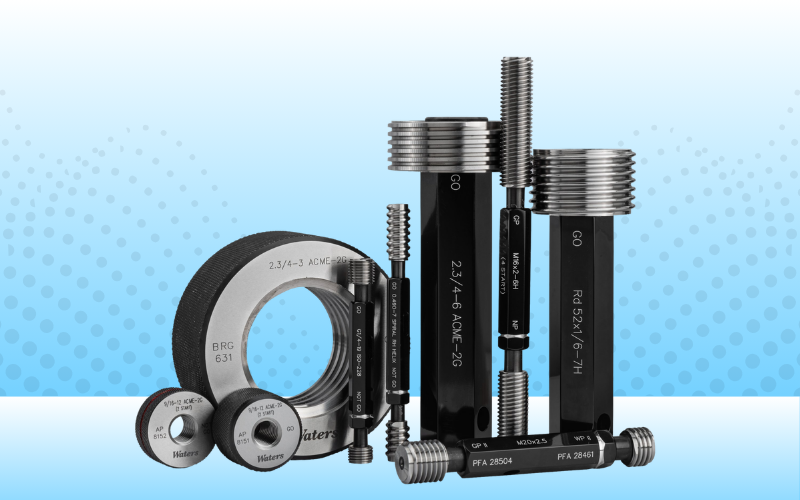
In manufacturing industries where threaded components are widely used, ensuring the accuracy of threads is critical for proper assembly and performance. Thread gauges are essential inspection tools used to verify whether internal and external threads meet specified standards and tolerances.
Among these tools, thread plug gauges and thread ring gauges are the most commonly used for thread inspection. Although both gauges are designed to check thread accuracy, they serve different purposes depending on whether the thread is internal or external.
What Is a Thread Plug Gauge?
A thread plug gauge is used to inspect internal threads, such as those found inside nuts, threaded holes, or tapped components.
It typically consists of two ends:
- GO gauge – Checks whether the thread is within the acceptable minimum size.
- NO-GO gauge – Ensures that the thread does not exceed the maximum tolerance limit.
The GO side should enter the threaded hole smoothly, while the NO-GO side should not enter beyond a certain number of turns. This method quickly confirms whether the thread meets dimensional specifications.
What Is a Thread Ring Gauge?
A thread ring gauge is used to inspect external threads, such as bolts, screws, and threaded shafts.
Like plug gauges, ring gauges also operate using the GO / NO-GO principle.
- The GO ring gauge should screw easily onto the threaded component.
- The NO-GO ring gauge should not fully engage with the thread.
This ensures that the external thread falls within the required tolerance range.
Key Differences Between Thread Plug Gauges and Thread Ring Gauges
- Application: Thread plug gauges inspect internal threads, while thread ring gauges are used for external threads.
- Design: Plug gauges are cylindrical and inserted into threaded holes. Ring gauges are circular and fit over threaded components.
- Inspection Method: Plug gauges verify thread size inside components, whereas ring gauges verify thread accuracy on bolts and shafts.
- Industrial Use: Both gauges are essential in industries such as automotive manufacturing, aerospace engineering, machine tools, and precision component production.
Importance of Thread Gauges in Manufacturing
Thread gauges play a critical role in maintaining product quality. Accurate threads ensure proper fastening, mechanical strength, and leak-proof connections in many industrial applications.
By using thread gauges during quality inspection, manufacturers can:
- Ensure proper thread fit and assembly
- Reduce rejection rates and defects
- Maintain dimensional accuracy
- Improve product reliability
Where We Come In
At Jupiter Traders, we provide a wide range of precision thread gauges designed for reliable and accurate thread inspection.
Our range includes:
- Thread plug gauges
- Thread ring gauges
- Go / No-Go gauges
- Customized gauging solutions
These tools are widely used by machine shops, automotive manufacturers, and engineering industries to maintain strict quality control standards.
Conclusion
Thread plug gauges and thread ring gauges are both essential tools for verifying thread accuracy. While plug gauges are used for internal threads, ring gauges inspect external threads. Using the correct gauge ensures precise measurements and reliable component assembly.